
The next phase of life insurance investing

The U.S. life and annuity industry entered 2026 from a position of strength. Earnings growth has supported higher surplus levels and stronger balance sheets, while individual annuity sales reached new records. Sales of registered index-linked annuities and fixed indexed annuities have been particularly strong, supported in part by favorable demographic trends. Conning believes that recent indicators suggest that 2026 may be another strong sales year.

Individual life insurance has also performed well. New annualized life insurance premiums increased 10% to more than $17.5 billion, while the number of policies sold rose 7%. At the same time, elevated book yields and strong returns from alternative and other risk assets have continued to support industry earnings.
However, the operating environment is evolving. Industry success is attracting new entrants and additional capital, increasing competitive pressure and the need for product differentiation. At the same time, potential lower interest rates or further spread compression could weigh on product demand and investment yields. Growing allocations to private credit and other less liquid or complex assets are also drawing increased scrutiny.
Against this backdrop, Conning believes that investment strategy may become an increasingly important differentiator for life and annuity insurers. Carriers have access to a broader range of investment opportunities, but must balance return objectives with liquidity, capital efficiency, asset-liability management and risk across the portfolio. How insurers navigate these trade-offs may meaningfully affect their ability to sustain profitable growth as market conditions evolve.
Understanding the forces reshaping life and annuity portfolios will therefore be critical as insurers position themselves for the next phase of the market cycle.
Life insurer asset allocations continue to evolve
Over the past decade, the life insurance industry has steadily adjusted portfolio allocations in response to changing interest rate environments, evolving liability needs and expanding investment opportunities.

Some of these changes have been tactical, while others reflect broader shifts in how insurers approach liquidity, portfolio income and diversification (see Figure 1).
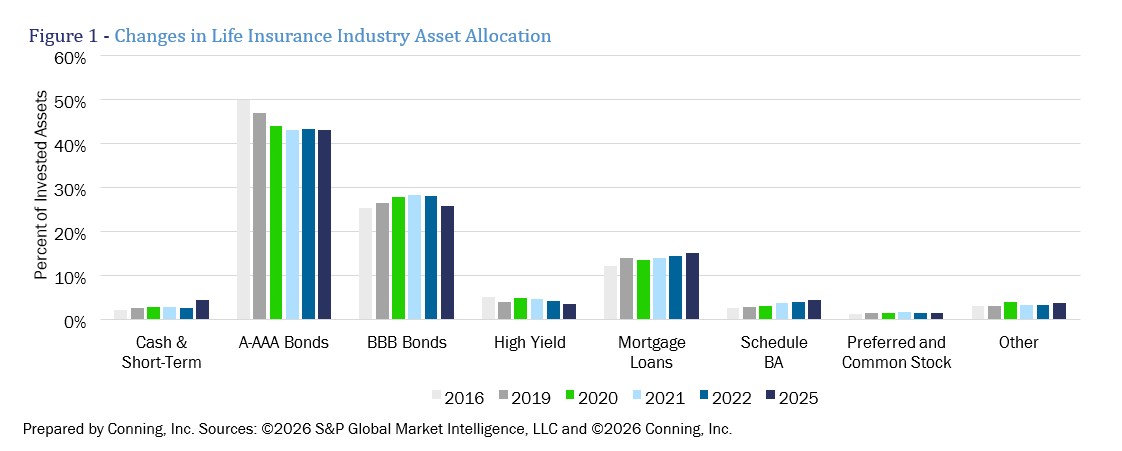
Like other institutional asset owners, life insurers have increased allocations to cash and short-term investments. Elevated short-term rates have allowed insurers to maintain liquidity while earning attractive yields. A decline in short-term rates could test whether insurers maintain these elevated liquidity positions or redeploy capital elsewhere in the portfolio.
The industry has also experienced significant rotation within its broader investment portfolio. Since 2016, the industry’s allocation to long-term bonds has declined from 80% to 72% of invested assets, reflecting a meaningful broadening of the traditional life insurer investment portfolio. Capital has shifted toward cash and short-term investments as well as less-liquid assets, including commercial mortgage loans and schedule BA assets.
The shift has been even more pronounced among annuity carriers, where bond allocations declined from 82% to 71%. Over the same period, commercial mortgage loan allocations increased from 11% to 17%, while Schedule BA allocations rose from 2% to 4%. These changes suggest that annuity carriers have become increasingly comfortable pairing certain liabilities with less liquid investments.
Asset allocation trends vary by insurer size
While several broad allocation trends are evident across the industry, the magnitude of these changes varies by insurer size.
Figure 2 compares changes in asset allocation among company cohorts based on cash and invested asset balances.
Several trends were generally consistent among groups:
- Lower allocations to BBB-rated and high-yield bonds
- Higher allocations to commercial mortgage loans, which may offer more capital-efficient income
- Higher allocations to Schedule BA assets, including limited partnerships and other less liquid investments
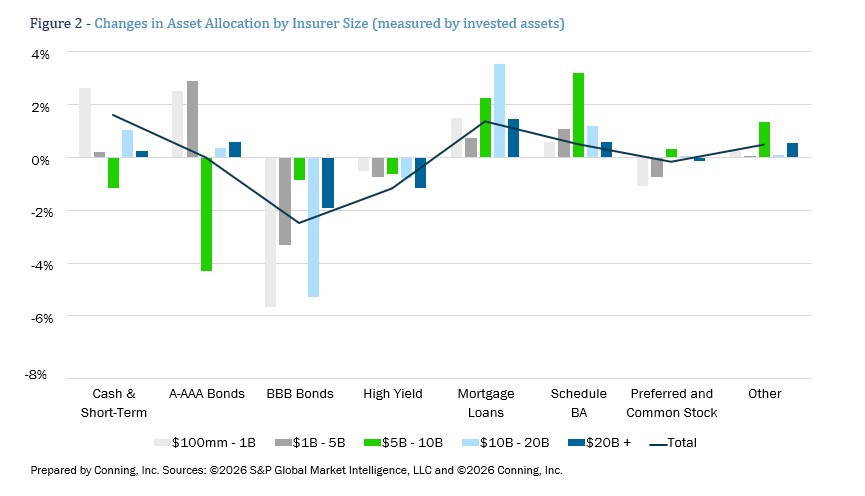
Combined allocations to commercial mortgage loans and Schedule BA assets increased most for companies with invested assets between $5 billion and $20 billion. The trend suggests that portfolio strategies once associated primarily with the industry’s largest insurers are becoming increasingly prevalent among midsize and smaller carriers. As access to more specialized investment strategies broadens, implementation, governance and portfolio integration will become increasingly important.
Structured securities continue to gain share
More detailed statutory reporting introduced at year-end 2025 allows for a more granular assessment of life insurers’ bond allocations, particularly exposure to structured securities.
Figure 3 shows bond-sector allocations across the industry and selected insurer composites. Structured securities now represent more than one-quarter of bond portfolios, reflecting their increasingly important role for life and annuity insurers. At year-end 2025, structured securities represented 26% of total industry bond portfolios. The growth has been particularly evident in asset-backed securities and collateralized loan obligations, which together increased from 8% of bond holdings in 2015 to 14% in 2025.
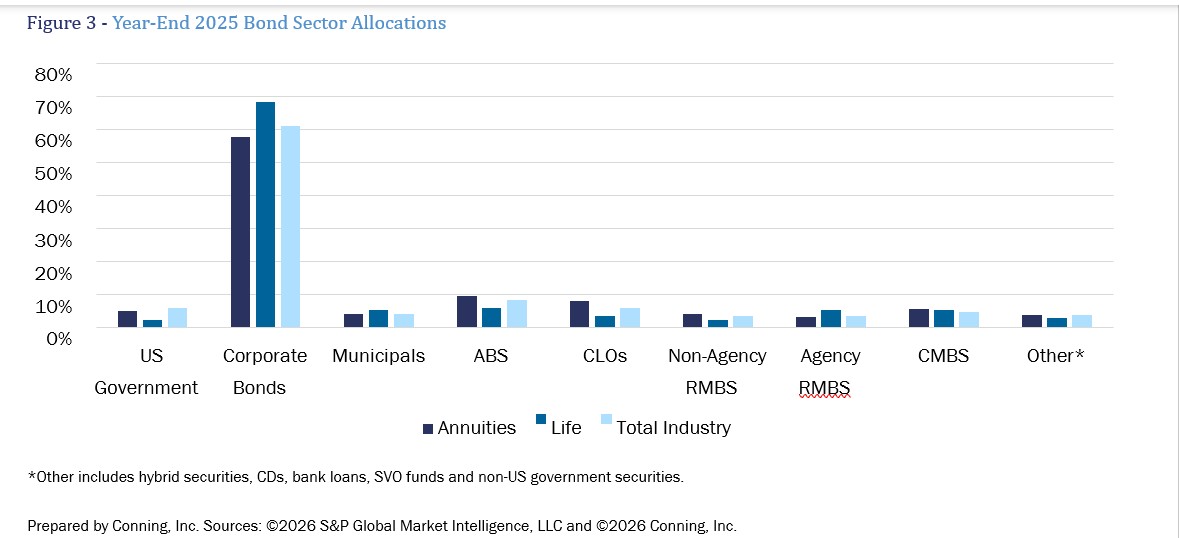
Annuity carriers maintain significantly higher allocations to structured securities than traditional life insurers. Structured securities represented 30% of bonds in our annuity composite compared with 22% for the life insurance composite. Shorter-duration structured securities may align more naturally with certain annuity liabilities, while the potential for attractive capital-adjusted yields has also supported greater utilization among annuity writers.
As allocations to structured securities have grown, corporate and municipal bonds have declined as a share of insurer bond portfolios. However, both sectors remain important in traditional life insurance portfolios, where their duration and credit quality can align well with longer-duration insurance liabilities.
A deeper dive on CLO allocations
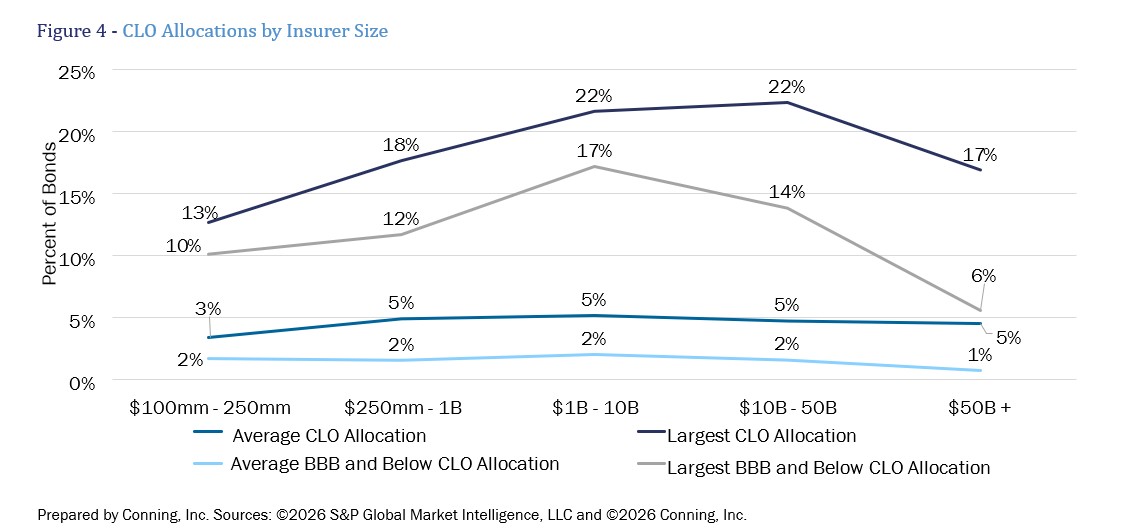
CLO utilization highlights one of the clearest differences between life and annuity portfolios. CLOs represented approximately 3% of bonds in the life composite compared with 8% in the annuity composite. The floating-rate and shorter-duration characteristics of CLOs may make them less suitable for a significant portion of traditional life insurance liabilities, while shorter annuity liability durations and the need for competitive yields may support greater utilization.
Figure 4 examines CLO allocations among insurers with exposure to the asset class. Average allocations generally increase with portfolio size before leveling off at approximately 5% of bond holdings. However, there is significant dispersion within each size category. The largest company-level CLO allocations range from 13% to 22% of bonds across the cohorts shown.
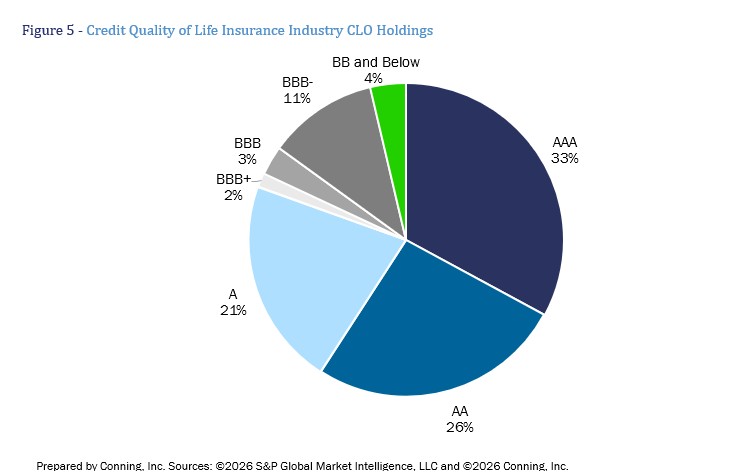
Changes to CLO capital treatment could influence future portfolio construction. Historically, CLOs received capital treatment in line with corporate bonds. Under the evolving framework, CLOs will receive differentiated capital charges based on their position within the capital structure. Higher-rated tranches may receive more favorable treatment, while junior tranches could face materially higher capital requirements. As a result, insurers’ existing credit-quality mix and position within the CLO capital structure may become increasingly important considerations in evaluating the asset class.
As structured securities have grown in insurer portfolios, average bond maturities have declined. Life insurers’ average bond maturity has remained relatively stable since 2021, ranging from 10.2 to 10.6 years. Annuity carriers, by contrast, have shortened portfolio maturity from 11.4 years in 2021 to 10.5 years at year-end 2025.
These shifts are typically driven more by liability and ALM considerations than by tactical interest-rate views. Future product flows could further influence this trend, particularly if higher rates continue to support demand for savings-oriented products and alter the liability mix insurers seek to match.
Positioning life and annuity portfolios for the next market cycle
The life and annuity industry remains well capitalized, stable and growing. However, sustained profitability may attract more competition and capital, while changes in interest rates, spreads, regulation and product demand may present new challenges for carriers to consider.
Insurers have continued to diversify their investment portfolios in pursuit of income and long-term value. The evolution of life and annuity portfolios extends beyond a simple search for yield, as insurers increase their use of commercial mortgage loans, Schedule BA assets, structured securities and CLOs. As portfolios have become more complex and less liquid assets have grown, carriers must ensure they have expertise across a range of disciplines from underwriting to asset modeling and asset-liability management. These strategies are not appropriate for every insurer and should be evaluated based on liabilities, liquidity, capital, governance and investment capabilities, with strong portfolio construction and risk management remaining essential. Increasing regulatory scrutiny across investments, including CLOs and private credit, reinforces the importance of a holistic approach to investment strategy design.
The insurers best positioned for the future may not simply be those pursuing higher returns, but those most effectively balancing return objectives with risk, liquidity, capital efficiency, and liability needs within a disciplined investment framework. Conning’s insurance-focused investment and insurance solutions teams work with life and annuity insurers to evaluate portfolio strategies, assess emerging opportunities, and understand investment decisions within the broader context of enterprise objectives and long-term financial performance.
© Entire contents copyright 2026 by InsuranceNewsNet.com Inc. All rights reserved. No part of this article may be reprinted without the expressed written consent from InsuranceNewsNet.com.
The post The next phase of life insurance investing appeared first on Insurance News | InsuranceNewsNet.