OLDWICK, N.J.–(BUSINESS WIRE)– AM Best has assigned a Financial Strength Rating of A++ (Superior) and a Long-Term Issuer Credit Rating of “aa+” (Superior) to Lasso Healthcare Insurance Company (Lasso) (Indianapolis, IN). The outlook assigned to these Credit Ratings (ratings) is stable.
The ratings reflect Lasso’s balance sheet strength, which AM Best assesses as very strong, as well as its adequate operating performance, neutral business profile and very strong enterprise risk management (ERM).
The very strong balance sheet assessment reflects Lasso’s strongest level of risk-adjusted capitalization, as measured by Best’s Capital Adequacy Ratio (BCAR), as well as its conservative investment portfolio. The assessment also considers the financial support provided by its parent, HCC Life Insurance Company (HCC Life).
The adequate operating performance assessment reflects the historical performance of the established captive program medical stop-loss business that will transition to Lasso. Although Lasso has yet to issue policies under its current strategy, HCC Life has written the underlying business for approximately 15 years, during which it has generated positive operating results. Management expects profitability to continue through the initial transition and deployment on Lasso paper. The continuity of personnel, management and operating infrastructure should support a smooth transition of the business.
The very strong ERM assessment for Lasso reflects Lasso’s integration into the established ERM framework of HCC Life and the broader Tokio Marine organization. Lasso will utilize the same management, systems, economic modeling and risk-management infrastructure as HCC Life. Lasso also benefits from established reinsurance oversight and participates in a whole-account quota-share arrangement within the Tokio Marine organization.
Finally, the ratings also recognize the operational and financial support provided by Lasso’s parent, ultimate parent and affiliated entities within the Tokio Marine organization. By helping alleviate the channel conflict at HCC Life, Lasso now assumes a role in supporting Tokio Marine’s broader international strategy and diversification of revenues and customer segments.
This press release relates to Credit Ratings that have been published on AM Best’s website. For all rating information relating to the release and pertinent disclosures, including details of the office responsible for issuing each of the individual ratings referenced in this release, please see AM Best’s Recent Rating Activity web page. For additional information regarding the use and limitations of Credit Rating opinions, please view Guide to Best’s Credit Ratings. For information on the proper use of Best’s Credit Ratings, Best’s Performance Assessments, Best’s Preliminary Credit Assessments and AM Best press releases, please view Guide to Proper Use of Best’s Ratings & Assessments.
AM Best is a global credit rating agency, news publisher and data analytics provider specializing in the insurance industry. Headquartered in the United States, the company does business in over 100 countries with regional offices in London, Amsterdam, Dubai, Hong Kong, Singapore and Mexico City. For more information, visit www.ambest.com.
South Carolina insurance regulators are taking another shot at placing two Advantage Capital Partners-owned insurers into rehabilitation. This time, they appear to have considerably more ammunition.
Director Michael Wise of the South Carolina Department of Insurance filed a 56-page petition Tuesday seeking to take control of insurers Atlantic Coast Life Insurance Co. and Southern Atlantic Re Inc.
Wise argued that A-Cap and CEO Kenneth King gambled on “high-risk and inappropriate investments” that “grievously undermined” the insurers’ financial condition.
“The risky investments appear to be worth substantially less than what Respondents forecast, and they cannot be turned into cash in time to pay policyholder obligations without taking substantial losses on the investments,” the petition states. “These improper investments threaten Respondents’ ability to pay back the thousands of mostly elderly policyholders who bought annuities and other insurance products from Atlantic Coast Life.”
Rehabilitation is a process through which financially-distressed insurers are placed into receivership with the intent of identifying the source of any underlying financial issues and working to remedy them.
If the court grants the petition, the insurers will be placed under the department’s control so regulators can thoroughly vet their finances.
“Filing this petition was a necessary step to protect policyholders and the broader public,” Wise said in a statement. “The department has been closely monitoring a number of concerning signs about the companies’ finances.”
Not the first time
In 2024, South Carolina regulators made multiple regulatory attempts to restrict and intervene in the operations of Atlantic Coast and Southern Atlantic Re due to mounting concerns over its finances and exposure to high-risk private credit
As financial concerns escalated, the department issued a cease-and-desist order on Dec. 11, 2024, that attempted to completely ban Atlantic Coast from writing any new insurance or annuity premiums in the state.
The new petition was filed in the Court of Common Pleas for the Fifth Judicial Circuit in Richland County. A-Cap immediately filed a motion to dismiss the petition on Wednesday, in part because the court “lacks jurisdiction,” the motion states, and the department “fails to state facts sufficient to constitute a cause of action.”
A-Cap also signaled its intent to fight regulators.
“Respondents also oppose the other filings by the Department to date and intend to file responsive briefing in opposition,” its two-page motion reads.
A-Cap could not be reached for comment by the time this story was published.
A shift to annuities
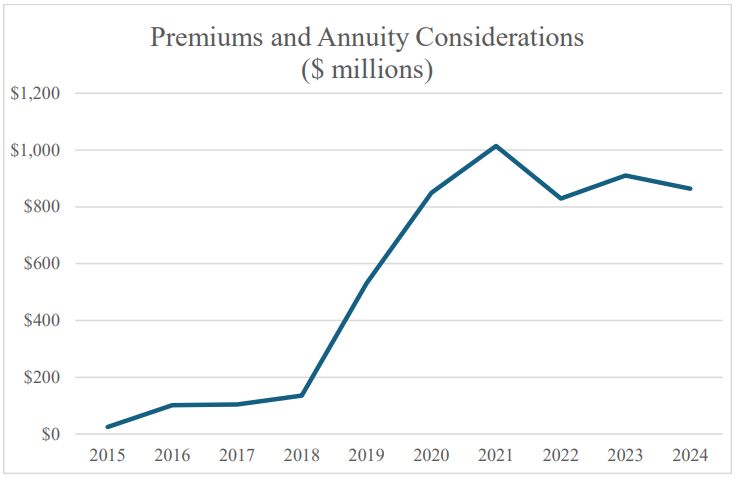
Founded in 1925, Atlantic Coast historically focused on small life insurance and pre-need funeral policies but shifted under A-Cap to selling annuities, regulators say. Its direct premium income and annuity considerations increased from about $25 million in 2015 to roughly $102 million in 2016, the petition says.
“This was a major change in Atlantic Coast Life’s business model and included significant changes to its investment strategy for policyholder funds, resulting in a vastly different risk profile for the company,” the petition states.
South Carolina regulators show how annuity sales spiked after A-Cap acquired Atlantic Coast Life in 2015.
Much of the petition focuses on the insurers’ investments in private-credit assets, including unrated collateral loans and below-investment-grade private-placement bonds. Private credit assets are privately negotiated loans and debt negotiated through non-bank lenders.
As of Dec. 31, 2025, Atlantic Coast reported that 23.8% of its cash and invested assets were in non-investment-grade private-credit bonds and unrated collateral loans. Southern Atlantic Re reported 10.8%.
The department says those figures understated the exposure because some assets were classified as highly rated bonds even though they should have been reported as unrated collateral loans.
After adjusting the classifications, regulators say 30.2% of Atlantic Coast’s cash and invested assets and 15.1% of Southern Atlantic Re’s were in those categories. The department alleges the investment levels exceeded limits contained in the companies’ investment-management agreements with Advantage Capital Management, an A-Cap-affiliated investment adviser.
The petition also alleges that investment expenses paid to advisers had grown to more than twice the industry average relative to the insurers’ size by 2025, while investment performance had remained largely in line with the broader life insurance industry.
“Even among life insurance companies owned by private equity firms, Atlantic Coast Life’s share of investments in non-investment grade bonds and unrated investments was double the average for this industry sector,” the petition states.
Troubled investments alleged
The filing points to several investments in financially troubled companies.
Southern Atlantic Re had more than $30 million invested in Film Services, a company created after Film Finances filed for bankruptcy in 2024 and was acquired in foreclosure by an entity 50% owned by A-Cap, according to the petition.
The department also cites a loan to Brickell PC Insurance Holdings that grew from $6 million to $34.5 million by the end of 2025, even as its maturity was extended and there was no indication the borrower was making interest payments.
Regulators said their investigation shows that the Brickell PC loan is likely “collateralized by shares of Randall & Quilter Investment Holdings Ltd., a company that filed for provisional liquidation in Bermuda following a period of financial distress, and which has since sold its profitable division to a third party.”
A major concern involves the insurers’ financial ties to 777 Partners, the Miami-based investment firm whose affiliated companies have faced financial distress, bankruptcy and federal criminal charges.
Southern Atlantic Re had reinsured more than $500 million of business with 777 Re Ltd. before recapturing more than $600 million of that business in 2024, ending the reinsurance relationship. The department says the transaction did not eliminate the insurers’ broader economic exposure to 777-related assets.
The petition claims the insurers and A-Cap-affiliated entities also had substantial investments tied to 777 Partners. One loan that originated at about $46 million grew to more than $700 million, with more than $100 million in accrued and unpaid interest by April 2024, according to the filing.
In 2025, the insurers’ management said the outstanding loan balance, including capitalized interest, had been converted into a new investment in Caboose Holdings, an A-Cap subsidiary. The department alleges that move did not eliminate the underlying exposure to 777-related assets.
The issue became more significant after 777 Partners and affiliated companies sought Chapter 11 bankruptcy protection in August. The petition says bankruptcy filings disclosed nearly $1.3 billion owed to A-Cap-affiliated companies, with all of those loans in default.
The department says that disclosure conflicted with an A-Cap statement from February that certain 777-related loans had been extinguished and that all legacy 777 risk had been removed.
“Personnel from A-CAP have maintained that they were not participants in any aspect of the fraud scheme but instead are pure victim-witnesses,” the petition notes.
RBC ratios deteriorate
The insurers’ risk-based capital ratios are another central issue.
South Carolina had required Atlantic Coast and Southern Atlantic Re to maintain RBC ratios of at least 500% as conditions of their respective regulatory approvals, according to the petition.
Atlantic Coast reported an RBC ratio of 278% at the end of 2024 and 239% at the end of 2025. Southern Atlantic Re reported 485% at the end of 2025. The companies’ second-quarter 2026 financial statements showed additional deterioration, the petition says.
Atlantic Coast Life’s capital and surplus fell from about $81.7 million at the end of 2025 to $47.4 million by June 30, a 42% decline in six months. Its estimated RBC ratio fell below 185%, according to the filing.
The petition says Atlantic Coast Life also had seven of 12 NAIC Insurance Regulatory Information System ratios outside their usual ranges in 2025, up from four in 2024. Southern Atlantic Re had four of 10 applicable ratios outside the normal range in both years.
Regulators further allege that correcting certain investment classifications and reinsurance credits would reduce the reported RBC ratios substantially.
For example, the petition says removing more than $150 million in excess investments tied to King and A-Cap from Atlantic Coast Life’s admitted assets would have pushed its Dec. 31, 2025, RBC ratio below zero.
Reinsurance concerns
The petition also challenges several reinsurance arrangements.
By the end of 2025, Southern Atlantic Re had assumed more than $2.36 billion in policyholder reserves from Atlantic Coast. Atlantic Coast, in turn, had ceded more than $2 billion of policyholder obligations to Southern Atlantic Re, according to the filing.
The department alleges that Atlantic Coast improperly claimed about $180 million in reinsurance credit for business ceded to Converge Re II and that Southern Atlantic Re improperly claimed about $245 million in credit associated with Aureum Re. The petition says certain assets backing those arrangements did not qualify for reinsurance credit under South Carolina law.
A “higher level of capital is necessary when holding unrated collateral loans compared to holding highly-rated long-term bonds to account for the additional risk inherent in the assets,” regulators say.
The department also alleges that some reinsurance arrangements are undercollateralized, potentially leaving Atlantic Coast Life exposed if counterparties cannot meet their obligations.
Liquidity pressures alleged
The petition says liquidity could become an increasing concern as large blocks of Atlantic Coast annuities reach the end of their surrender-charge periods.
According to company records cited in the filing, annuities with about $900 million in gross fund value are scheduled to reach the end of their surrender-charge periods in 2026, followed by another $900 million in 2027 and $800 million in 2028.
Net of reinsurance, the amounts are nearly $400 million, nearly $300 million and $150 million, respectively.
Policyholders surrendered $463 million in annuity value during the first half of 2026, or $165 million net of reinsurance, according to the petition.
“Respondents’ investments should be structured so that sufficient amounts can be turned into cash near the end of the annuities’ surrender charge periods to match the large volume of expected surrenders,” the petition states.
Atlantic Coast Life also reported a 2025 net operating loss of $25.2 million before capital gains and losses, exceeding a statutory threshold cited by the department by about $9.2 million. Through the second quarter of 2026, its year-to-date operating loss was $14.8 million, the petition says.
The department began a full-scale examination of the insurers in August 2025. The examination remains ongoing and a final report had not been issued when the petition was filed.
SINGAPORE–(BUSINESS WIRE)– AM Best has affirmed the Financial Strength Rating of A- (Excellent) and the Long-Term Issuer Credit Rating of “a-” (Excellent) of Allianz Ayudhya General Insurance Public Company Limited (AAGI) (Thailand). The outlook of these Credit Ratings (ratings) is stable. Concurrently, AM Best has assigned a Thailand National Scale Rating (NSR) of aaa.TH (Exceptional) to AAGI. The outlook assigned to the NSR is stable.
The ratings reflect AAGI’s balance sheet strength, which AM Best assesses as strong, as well as its adequate operating performance, limited business profile and appropriate enterprise risk management. In addition, AAGI benefits from rating enhancement from Allianz SE (Allianz Group).
AAGI’s balance sheet strength assessment is assessed as strong, supported by its strongest level of risk-adjusted capitalisation at year-end 2025, as measured by Best’s Capital Adequacy Ratio (BCAR). The company benefits from strong financial flexibility with access to capital markets through its listed parent holding company, Allianz Ayudhya Capital Public Company Limited [SET: AYUD]. AM Best views AAGI’s investment strategy as conservative, with the majority of its investments allocated to cash, deposits and high-quality bonds. The company has a moderate reliance on reinsurance to support its underwriting capacity and manage its exposure to catastrophic events. However, this risk is partially mitigated by the high credit quality of the reinsurance panel.
AAGI’s operating performance is assessed as adequate, with a return-on-equity ratio of 2% in 2025 (2024: 3.8%). In 2025, AAGI’s loss ratio was negatively impacted by higher claims arising from earthquake and flood events. However, this was partially mitigated by an improved loss experience in health insurance, resulting from remedial actions taken by the company. AAGI’s operating performance remained profitable in the first half of 2026. The company’s stable investment income, which is comprised of mainly interest income, continues to support overall profitability. Prospectively, AM Best anticipates that AAGI will sustain an adequate operating performance level, supported by its growth strategy while maintaining prudent underwriting and pricing discipline.
AM Best assesses AAGI’s business profile as limited. AAGI is a non-life insurer operating in Thailand and ranks as the ninth largest general insurer, with a market share of 4%, based on gross premiums written in 2025. The company’s underwriting portfolio is well-diversified by line of business and distribution channels. However, it has limited geographic diversification as it only offers its products in Thailand. The company is projected to generate robust premium growth over the medium term, primarily driven by its business initiatives and the strengthening of its distribution channels.
The rating enhancement from Allianz Group reflects the explicit and implicit support AAGI receives from the group. AAGI receives explicit support in the form of reinsurance from Allianz Group. In addition, the company benefits from implicit support in areas such as corporate governance and investment management services, as well as access to shared resources and services across various business functions. Although AAGI’s operations account for a small portion of the group’s consolidated revenue, the company is considered strategically important to Allianz Group’s expansion strategy.
Ratings are communicated to rated entities prior to publication. Unless stated otherwise, the ratings were not amended subsequent to that communication.
This press release relates to Credit Ratings that have been published on AM Best’s website. For all rating information relating to the release and pertinent disclosures, including details of the office responsible for issuing each of the individual ratings referenced in this release, please see AM Best’sRecent Rating Activity web page. For additional information regarding the use and limitations of Credit Rating opinions, please view Guide to Best’s Credit Ratings. For information on the proper use of Best’s Credit Ratings, Best’s Performance Assessments, Best’s Preliminary Credit Assessments and AM Best press releases, please view Guide to Proper Use of Best’s Ratings & Assessments.
AM Best is a global credit rating agency, news publisher and data analytics provider specialising in the insurance industry. Headquartered in the United States, the company does business in over 100 countries with regional offices in London, Amsterdam, Dubai, Hong Kong, Singapore and Mexico City. For more information, visit www.ambest.com.
NEW YORK–(BUSINESS WIRE)–
Winged Keel Group (“Winged Keel”) is excited to announce the addition of Scott Henderson as a Senior Director and Client Relationship Manager. Based in Ohio, Henderson will support Winged Keel’s continued growth by expanding the firm’s relationships with financial institutions and advisors across Ohio, Michigan, and Indiana, further strengthening the firm’s presence in the Midwest. Henderson reports to Donna Litke, Managing Director, Sales and Development, at Winged Keel.
“We are pleased to welcome Scott to Winged Keel,” said Litke. “His extensive experience and deep relationships across the Midwest, as well as his proven ability to help financial institutions and advisors integrate sophisticated life insurance strategies, make him an important addition. We look forward to his contributions as we continue to expand our institutional relationships nationally.”
Henderson’s career in the financial services industry spans more than 30 years. Prior to joining Winged Keel, he was an insurance strategist with Crump Life Insurance Services, where he provided insight, knowledge, and resources to financial advisors to align life insurance planning with client goals. Henderson has also held various positions with national organizations where he delivered specialized life insurance support to wirehouses and independent financial professionals. He has his life, annuity, and health insurance licenses and holds FINRA Series 7, 63, and 65 licenses.
“I’m proud to join Winged Keel and contribute to a team with a strong track record of collaborating with financial institutions and advisors to support the evolving needs of high-net-worth clients,” said Henderson. “I look forward to building on that momentum, expanding relationships across the Midwest, and delivering thoughtful, innovative solutions alongside my new colleagues.”
Welcoming Henderson underscores Winged Keel’s continued momentum following the formation of a strategic partnership with GTCR in 2025, reinforcing the firm’s commitment to investing in its platform, expanding into new markets, and delivering world-class solutions to clients and partners.
Securities offered through M Holdings Securities, Inc., a Registered Broker/Dealer, Member FINRA/SIPC. Winged Keel Group is independently owned and operated. #09162026-5922887
About Winged Keel Group
Winged Keel Group is the premier national platform for the structuring, implementation, and administration of high-end life insurance solutions. With coverage teams across 20 markets nationally, the firm specializes in Traditional Life Insurance, Business Continuation Insurance, Private Placement Life Insurance and Annuities, and Executive Benefits Insurance portfolios. For more information on Winged Keel Group, please visit www.wingedkeel.com.
Danny Sheckles is alleging that his reassignment from Wynn Elementary principal to a teacher at Campbell County High School — as well as his failed attempts to be hired as a principal at other schools in the district — is a result of age discrimination against him.
Sheckles is also alleging that he is getting retaliated against for applying to be director of schools.
Sheckles is seeking more than $500,000 in relation to the matter, as an alternative to getting restored to an administration position in Campbell County’s school district, at the same pay and benefits he previously received, according to a letter from Sheckles’ attorney. Broken down, that is $375,673.54 for “two years’ salary, bonuses, health, disability and life insurance, retirement contributions, vacation, PTO, education and training reimbursements, and all other pay and benefits for which Dr. Sheckles received and/or would have received as Principal of Wynn Habersham Elementary School,” $250,000 for “damage to reputation, pain, suffering, and anguish as a result of his discriminatory and defamatory treatment by Campbell County Schools,” plus attorneys’ fees.
“In lieu of filing charges of discrimination, defamation and retaliation, Dr. Sheckles is willing to enter into an agreement that would restore his status, salary, retirement contributions and benefits with the Campbell County School System at the administrative level he was receiving as Principal of Wynn Habersham Elementary School, his pain, suffering and damages to date, plus his costs and attorneys’ fees to date, and/or that is necessary should he be required to file charges and/or suit to compensate him for the damages he has suffered as a result of his recent demotion,” Sheckles’ attorney, Karen G. Crutchfield, wrote in a letter.
Sheckles is also seeking removal of any negative personnel files with the local school board and state board, plus a mutual anti-disparagement agreement and a neutral employment reference. If he received everything he asked for, he would retire and release all claims.
Crutchfield sent the letter, dated Aug. 3, to Campbell County Director of Schools Charlotte McCoy regarding the matter.
“Please allow this letter to serve as notice of my representation of tenured educator and former administrator for the Campbell County Schools, Dr. Danny Sheckles, in regard to recent adverse, discriminatory and defamatory employment actions taken against him in violation of the Age Discrimination in Employment Act , 29 U.S.C. §§ 621-634, et seq., (ADEA) and the Tennessee Human Rights Act, (THRA) 4-21-101, et seq.,” Crutchfield wrote.
While other principals in the district were moved this past summer — such as Ben Foust from Campbell County High School principal to Jellico Elementary principal or Charli Johnson from Jellico Elementary principal to Caryville Elementary assistant principal — they still remained administrators. Sheckles did not.
“As you are aware, Dr. Sheckles was recently removed as Principal of Wynn Habersham Elementary School effective June 11, 2026, and demoted to a classroom teaching position, despite his years of experience, qualifications and credentials as both an educator and administrator with the Tennessee Board of Education, his exemplary record as a teacher and administrator for over 41 years, and despite having any negative employment evaluations or disciplinary actions in his record,” Crutchfield wrote. “The only reason given for his abrupt removal from the administrative position at Wynn Habersham Elementary School, and demotion to a classroom teaching position was that ‘he did not fit’ with your ‘new vision for the district.'”
There is no record of any past suspensions, warnings or other disciplines in Sheckles’ personnel file, obtained by the LaFollette Press.
“Despite his years of experience, qualifications, and exemplary personnel record with the Campbell County Schools, Dr. Sheckles was discriminated against by Campbell County Schools a second time, when he was not considered for other administrative positions that were open within the District,” Crutchfield wrote. “His application for the publicly posted position of Principal of Campbell County High School was not even acknowledged, nor was he granted an interview for this position. As more fully discussed in the attached draft EEOC Charge Dr. Sheckles is prepared to file, the educators selected for the administrative positions at Wynn Habersham Elementary and Campbell County High School were both significantly younger than Dr. Sheckles, as well as being less qualified and having fewer years of experience as both educators and administrators.”
According to Campbell County Schools, the following people applied to be CCHS principal: Heather Wallace, Craig Ivey, Martha Meredith, Brad Collette, Shawn West, Danny Sheckles, Sindi Jeffers and Arthur Wright.
Ultimately Collette, who has served as an administrator at Campbell County High School, Clinton High School and Hardin Valley Academy, was chosen to be the new CCHS principal.
According to Campbell County Schools, Sindi Jeffers, Mary Seiber, Raymond Day, Danny Sheckles and Arthur Wright applied to be Elk Valley principal this year, with Seiber getting the job.
“Another example of how Dr. Sheckles has been treated adversely as a result of his age and tenure, is the treatment of a younger, female district administrator, who received a formal reprimand for an alleged violation of the Teacher Code of Ethics, but who was not demoted, reassigned, or reduced in pay or benefits,” Crutchfield wrote. “This younger, female administrator, who is approximately 37 years
old, remained in district administration through reassignment to an assistant principal position, despite receiving documented disciplinary action. In contrast, Dr. Sheckles has no history of disciplinary actions, no reprimands, no performance improvement plans, and no documented performance concerns, yet he was removed from administration, demoted to the classroom, and had his pay, benefits and retirement contributions significantly reduced. In addition to being discriminatory, this demotion is defamatory – demoting Dr. Sheckles from an administrative position to a classroom position suggests to his colleagues and the community that there is a disciplinary reason for such significant reduction in position and pay.”
Crutchfield was referring to Johnson, who received a written reprimand earlier this year regarding an alleged incident in April.
“Charli was seen on a recording of the incident pulling glasses off of a student’s face,” according to the reprimand notice. “It was also visible on the recording that she was upset and had her hand/finger within the personal space (inches) from the student’s face.”
Johnson hadn’t gotten a warning before, and the corrective action was this: “written reprimand from interim director of schools to document and discuss the conduct with student as shown on recording.”
Tiffany Bruce said more than 25 people contacted McCoy in an effort to keep Johnson from getting reassigned.
“Also, the glasses that were allegedly pulled off of that student’s face were not prescription glasses,” Bruce said. “They were sunglasses from a party that were star-shaped.”
McCoy told the LaFollette Press she could not comment on personnel matters.
“It would appear that the current administration of Campbell County Schools is making a concerted effort to embarrass, humiliate, and disparage Dr. Sheckles, and damage his personal and professional reputation, in an effort to force him to retire,” Crutchfield wrote. “Dr. Sheckles will not retire or voluntarily quit under these circumstances. Dr. Sheckles cannot help but believe that in addition to his age, tenure, and years of experience with Campbell County Schools, he is being retaliated against because he was one of the candidates for the position of Director of Schools for Campbell County Schools.”
The letter from Crutchfield sought a response on or by Aug. 17.
“Unless Campbell County Schools is willing to immediately discuss a resolution of the discriminatory and defamatory actions it has taken in regard to Dr. Sheckles’ employment, Dr. Sheckles intends to file charges with the Equal Employment Opportunity Commission, (EEOC), and the Civil Rights Enforcement Division (CRED) of the Tennessee Attorney General’s Office on or before August 17, 2026,” Crutchfield wrote.
According to the school district, Martha Meredith, Kristy Bloy, David Seals, Nikki Lawson, Sammantha Ashley, Allison Poston and Heather Wallace applied to be Wynn principal this year, with Poston getting the job.
“Please also allow this letter to serve as a Request/Notice that Campbell County Schools has a duty to preserve, segregate and protect from destruction, all physical evidence, documents, and data, including but not limited to, calendars, budgets, personnel records and evaluations of all administrators in Campbell County Schools, documentation of the decision making process and personnel recommendations submitted to the Board of Education, or any of its Members for the 2026-27 school year, all electronically stored data or communications in any form (i.e., typed or hand written, audio, video, etc.), or that is contained or maintained in any county, school, and/or intranet, software application, social or other media platform, that is, or may be relevant to any claims made by Dr. Sheckles and/or defenses raised by Campbell County Schools in this legal matter. See, e.g., 29 C.F.R. § 1602.14; Tennessee Public Records Act, (TPRA), § 10-7-503(a)(2)(A), Tenn. Code Ann. § 39-16-503- 504; and Rule 34 of the Tennessee Rules of Civil Procedure,” Crutchfield wrote. “Please note that not only is it a crime for public records to be altered, modified or destroyed under Tennessee Law, sanctions may be imposed for even accidental or negligent spoliation of evidence. Tatham v. Bridgestone Americas Holding, Inc., 473 S.W.3d 734 (Tenn. 2015).”
OKLAHOMA CITY — The state Insurance Department announced that Oklahoma consumers matched with more than a quarter of a billion dollars in life insurance and annuity benefits through the Life Insurance Policy Locator (LIPL). This free tool helps beneficiaries find unclaimed policies.
Since January 2017, more than 13,000 Oklahoma residents have submitted search requests, which resulted in confirmed matches totaling $260 million in benefits as of July 2026. That included more than $40 million in benefits so far this year.
“Life insurance can be critical to families during a time of loss,” Insurance Commissioner Glen Mulready said. “Unfortunately, navigating old paperwork or locating missing policies can be overwhelming. This tool ensures Oklahomans can finally connect with benefits that are rightfully theirs.”
The LIPL, hosted by the National Association of Insurance Commissioners (NAIC), securely searches participating insurance companies on behalf of beneficiaries to identify existing life insurance policies or annuity contracts — at no cost.
How to use LIPL
Visit the secure, encrypted Life Insurance Policy Locator.
Submit a request with the deceased’s information, including their Social Security number, legal name, date of birth, and date of death.
If a match is found and the requester is confirmed as the beneficiary, the insurance company will contact them directly. Searches may take 90 business days or more to complete.
A response is sent only if a match is found and the requester is the beneficiary.
The NAIC’s online tool has received more than 1.5 million policy search requests. As a result, insurance companies have reported more than 780,000 matches with life insurance policies or annuities totaling more than $16 billion through July 31, 2026.
Consumers with questions about life insurance should contact the Oklahoma Insurance Department at (800) 522-0071 or visit oid.ok.gov.
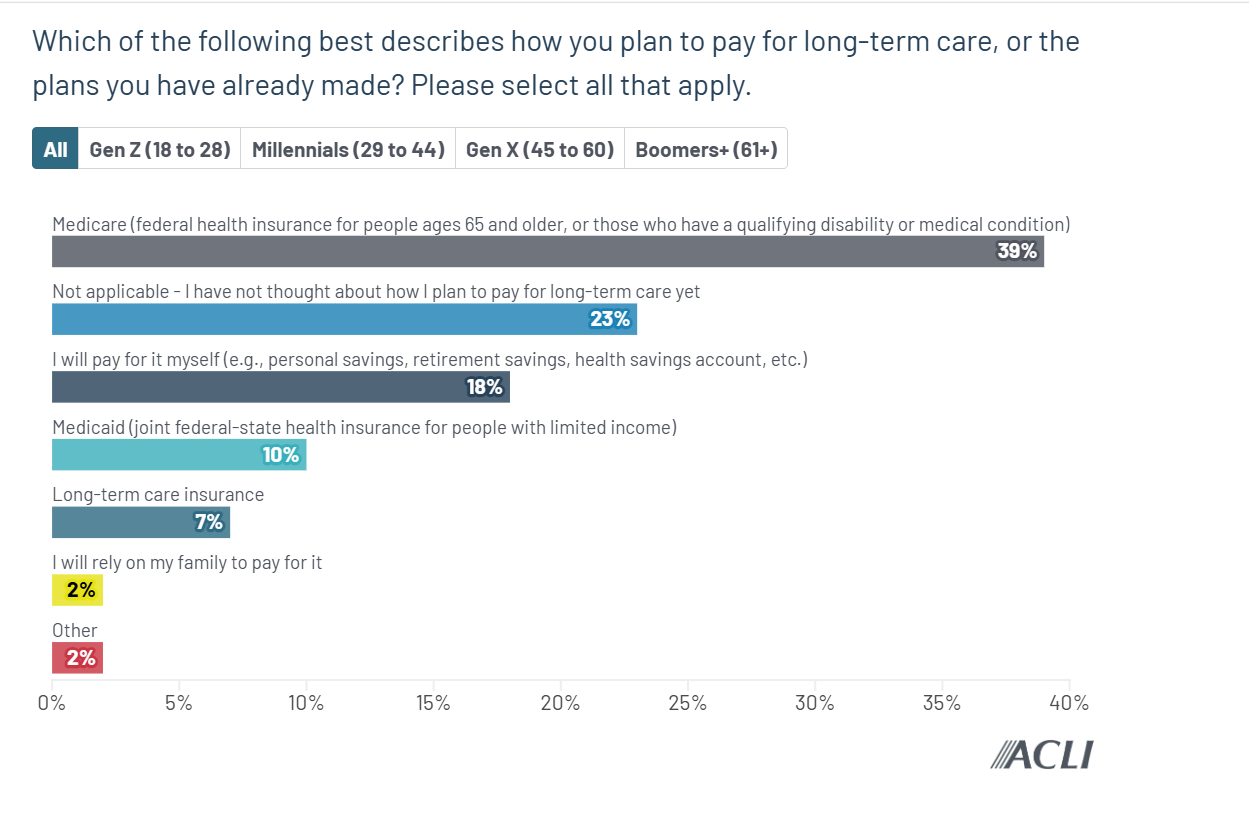
Nearly 40% of middle-class Americans said they plan to use Medicare to cover their future long-term care expenses – even though Medicare doesn’t cover LTC. In addition, nearly a quarter of Americans haven’t even considered how they will pay for LTC, meaning that more than 60% of Americans are financially unprepared for health challenges as they age.
Those were among the highlights of the American Council of Life Insurers’ latest Financial Resilience Index.
The cost of future care – and how consumers will pay for it – is a subject that the life insurance industry must address in two ways, David Chavern, ACLI president and CEO, told InsuranceNewsNet.
“One, we have to talk about it,” he said. “Two, the life insurance industry is interesting in that we sell products to help people deal with the scariest things in their life, savings products for retirement and long-term care, and we must do a better job of explaining what long-term care products are out there, and all the benefits they have.”
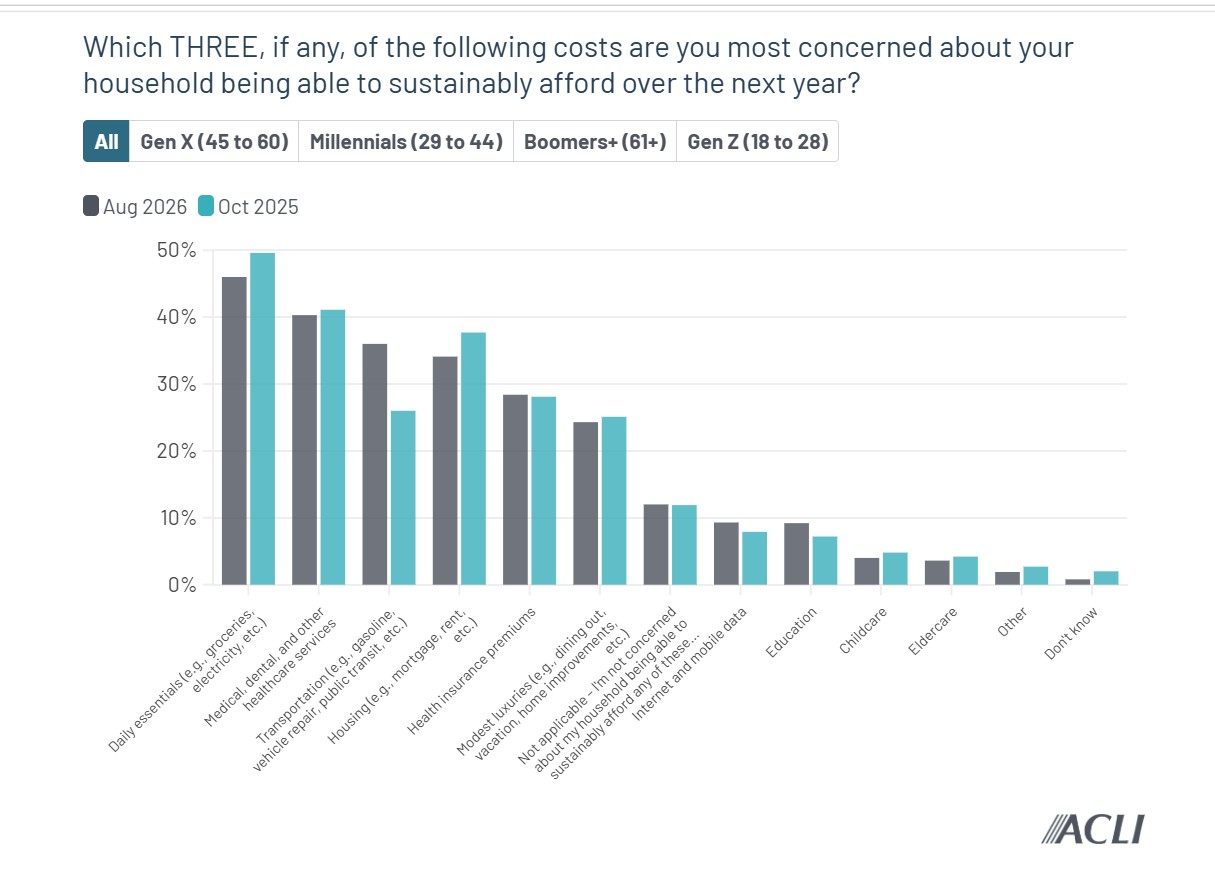
The survey also found that middle-class households are most concerned about affording daily essentials (46%), healthcare services (40%) and transportation (36%) over the next year. Concerns about the affordability of transportation costs rose substantially over the past year (from 26% to 36%).
Concerns around the affordability of healthcare increase significantly with age, but the biggest gap is between Generation Z and millennial households: slightly more than a quarter of Gen Z is concerned about healthcare costs, compared to nearly two-fifths of millennials.
Consumers feel ‘unease’
Chavern said the survey results showed that while many consumers see the stock market climbing, “there’s an unease that’s seeped in, where they’re not particularly optimistic about the near term. People are glad the markets are up, but they don’t think that’s the whole story.”
The industry can play a part in helping alleviate consumers’ financial fears “by letting them know we have a suite of tools to help them manage risk,” he said.
“I think people can feel helpless. But there are tools that can give you a solid base. We’re not solving all the problems but we have tools, and once you know about those tools, you can approach things with less anxiety. I think what the industry must do is meet people where they are and help them work through their anxieties and show them that a lot of solutions are possible.”
ACLI’s Financial Resilience Index, which is released quarterly, measures the ability of the middle class to manage life’s challenges and plan for a stable future. The index tracks 26 variables that represent typical cost pressures for middle-class households (like housing, gas and childcare) through the Cost Resilience Index and the financial resources that are available to meet them (like income, access to credit and retirement assets) through the Resource Resilience Index. By tracking the direction and magnitude of cost pressures and resources, the index reflects how middle-class financial resilience changes over time, and what is driving improvement or decline.
These concerns are reflected in the Q2 Index, which fell 10 points between Q1 and Q2 2026. While the Headline Index remains at a modestly positive score of +10, indicating that middle-class financial resilience is still reasonably strong relative to historical norms, the pace of improvement is slowing.
The downward movement in the Headline Index in the second quarter reflects another emerging financial challenge for middle-class households: slowing wage growth and persistent inflation. Inflation has outpaced wage growth since April, and this wage-price dynamic is a key reason for the decline in Headline Index in Q2.
North Country Assemblyman Ken Blankenbush, R-Black River, was honored with the Distinguished Insurance Service Award from the Professional Insurance Agents of New York State Inc. during the organization’s annual business meeting in Albany.
The award recognizes an individual for significant contributions to and support for the insurance industry. Blankenbush was recognized for his work on insurance issues and his service on the New York State Assembly Standing Committee on Insurance, where he has served as ranking minority member.
Blankenbush represents the 117th Assembly District, which includes all of Lewis County and parts of St. Lawrence, Jefferson and Oneida counties.
Before entering public service, Blankenbush worked in the insurance industry. He began working for Metropolitan Life Insurance Company in 1976 and eventually became branch manager of its Watertown office before founding BEL Associates, an insurance and financial services business.
“I am deeply grateful to PIA New York for this award and for the partnership we have shared over the years,” said Blankenbush. “Public service eventually comes to an end, but the obligation to leave our communities stronger than we found them must endure. I am proud of the work we have done together and deeply honored by this recognition.”
PIANY presented the Distinguished Insurance Service Award as part of its annual Awards of Distinction. The organization represents independent insurance agents across New York and provides education, advocacy, industry information and business resources to its members.
MONTPELIER, Vt.–(BUSINESS WIRE)–
National Life Group has been recognized on Forbes list of America’s Best Insurance Companies 2027, previously making the list in 2024 and 2025. This prestigious award is presented in collaboration with Statista, the world-leading statistics portal and industry ranking provider. The award list was announced on September 15, 2026, and can be viewed on the Forbes website.
America’s Best Insurance Companies 2027 ranking is based on an independent survey of over 18,000 U.S. citizens. The award list has been categorized into five insurance types: Auto, Homeowners, Renters, Permanent Life and Term Life. The survey considered customers’ overall recommendations, their general satisfaction, their loyalty, and the six subdimensions: Advice, Customer Service, Price/Performance, Transparency, Digital Services, and Damage/Benefit Service.
For each insurance type, the insurance companies with the highest score have been awarded. This prestigious recognition honors the most trusted, innovative, and high-performing insurers across the nation. National Life Group is honored to be recognized on the Forbes list of America’s Best Insurance Companies 2027.
“Being named one of America’s Best Insurance Companies is especially meaningful because it reflects the experiences of the people we have the privilege to serve,” said Mehran Assadi, Chair, CEO and President of National Life Group. “For 178 years, National Life has been built on keeping our promises and bringing peace of mind to families. This recognition is a testament to our associates and agents who bring that commitment to life every day and continue to earn the trust of our customers.”
About Statista: Statista publishes hundreds of worldwide industry rankings and company listings with high-profile media partners. This research and analysis service is based on the success of statista.com, the leading data and business intelligence portal that provides statistics, relevant business data and various market and consumer studies and surveys.
About National Life Group
National Life Group has been keeping promises since 1848, providing access to flexible, secure life insurance and annuities for families, businesses, educators, and first responders nationwide. With an independent, entrepreneurial spirit, our values are to “Do good, Be good, Make good” for our customers, agents, employees, and the communities we serve. Learn more at NationalLife.com.
National Life Group® is a trade name of National Life Insurance Company (NLIC), Montpelier, VT, founded in 1848, Life Insurance Company of the Southwest (LSW), Addison, TX chartered in 1955, and its affiliates. Each company is solely responsible for its own financial condition and contractual obligations. LSW is not an authorized insurer in New York and does not conduct insurance business in New York. NLIC, the flagship of National Life Group was founded in 1848, and all references to 1848 are attributable to NLIC.
Products are issued by National Life Insurance Company and Life Insurance Company of the Southwest.
New Extended No Lapse Guarantee Rider lets policyholders lock in a guaranteed death benefit while keeping market-linked growth potential, addressing a growing need
AT A GLANCE
New York Life has added an optional Extended No Lapse Guarantee Rider (ENLG) to its survivorship variable universal life (SVUL) insurance solution, making a guaranteed protection option available for an additional charge to families looking to protect, preserve, and ultimately transfer the wealth they have built.
The new option preserves a guaranteed death benefit after the death of the second insured, regardless of market performance, while the policy’s cash value remains invested across market-based options.
New York Life’s Wealth Watch 2026 Midyear Outlook consumer survey found that 84% of Americans believe a financial strategy should address both growth and protection. Survivorship variable universal life is designed to support both priorities, and adding a guaranteed death benefit gives families greater certainty around the protection outcome while preserving the policy’s growth potential.
The guaranteed death benefit option is available to clients in most states as of August 2026, through New York Life financial professionals.
NEW YORK–(BUSINESS WIRE)–
New York Life today added an optional Extended No Lapse Guarantee Rider to SVUL Accumulator II, its survivorship variable universal life (SVUL) insurance solution. The new option enables clients, typically spouses or business partners, to lock in a death benefit that is guaranteed against lapse. It pays out after the death of the second insured, regardless of how markets perform, while keeping the policy’s cash value invested across a range of market-based options. The product is available in most states through New York Life financial professionals.
“Families and business owners are not only asking how to build wealth. They are asking how to protect it, how to transfer it efficiently, and how to make sure their plans hold up over time,” said Ramon Casanova, head of Life Insurance Solutions at New York Life. “SVUL and our new Extended No Lapse Guarantee Rider option give them a solution that combines long-term protection, market exposure, wealth transfer potential and estate planning flexibility.”
Balancing Growth Potential and Protection
How SVUL Accumulator II Works
SVUL Accumulator II is a permanent life insurance policy that covers two lives under a single contract, paying a death benefit after the death of the second insured. Because the policy’s cash value can be allocated across a range of market-based investment options, clients can participate in market growth over a multi-decade planning horizon, a relevant feature for legacy strategies that may span generations.
Market exposure, however, means policy values can fluctuate. This new rider protects the death benefit: as long as the rider’s premium test is met, the rider allows clients to maintain a specified guaranteed death benefit even if investment performance changes, decoupling the legacy goals from market outcomes.
Why a Guaranteed Option, and Why Now?
For families and business owners using survivorship life insurance as a legacy planning tool, the ability to guarantee the death benefit against lapse offers certainty and clarity within a legacy strategy. The New York Life Wealth Watch 2026 Midyear Outlook found that 84% of Americans believe a financial strategy should address both growth and protection. Survivorship variable universal life is designed to support both priorities, and adding a guarantee against lapse of the policy gives families greater certainty around the protection outcome while preserving the policy’s growth potential.
Though market conditions and financial needs may change over a multi-decade planning horizon, the long-term objectives behind a legacy strategy often do not. Combining SVUL with the new option provides clients both certainty and growth potential.
Availability and Access
SVUL Accumulator II and the Extended No Lapse Guarantee rider are available in most states as of August 2026. Clients can learn more or connect with a New York Life financial professional at newyorklife.com/products/insurance/variable-universal-life.
FREQUENTLY ASKED QUESTIONS
What is SVUL Accumulator II?
SVUL Accumulator II is a survivorship variable universal life insurance policy from New York Life that covers two lives, typically spouses or business partners, under a single contract and pays a death benefit after the death of the second insured.
What does the new Extended No Lapse Guarantee rider do?
The new Extended No Lapse Guarantee rider allows policyholders to lock in a specified death benefit that will be paid regardless of market performance. It is available as an addition to SVUL Accumulator II. The rider does not eliminate market risk in the underlying investments of the VUL policy during the period in which assets can accumulate.
Who is SVUL Accumulator II designed for?
The product is designed for clients with long-term legacy and estate planning needs, including married couples and business partners who want to provide for heirs or fund buy-sell arrangements across a multi-decade time horizon.
Where is SVUL Accumulator II with the Extended No Lapse Guarantee rider available?
The product is available in most states as of August 2026 through New York Life financial professionals.
Why is this relevant now?
New York Life’s Wealth Watch 2026 Midyear Outlook found that 84% of Americans believe it is important for a financial strategy to address both growth and protection. For families with long-term commitments, that can mean wanting assets to retain market-linked growth potential while also seeking greater certainty around what will ultimately be available for beneficiaries. A guaranteed death benefit allows those two priorities to coexist within the same policy.
ABOUT NEW YORK LIFE
New York Life Insurance Company (www.newyorklife.com), a Fortune 100 company founded in 1845, is the largest1 mutual life insurance company in the United States and one of the largest life insurers in the world. Headquartered in New York City, New York Life’s family of companies offers life insurance, disability income insurance, retirement income, investments, and long-term care insurance. New York Life has the highest financial strength ratings currently awarded to any U.S. life insurer from all four of the major credit rating agencies.2
1 Any guarantees are based on the claims-paying ability of the issuer.
2 Based on revenue as reported by “Fortune 500 ranked within Industries, Insurance: Life, Health (Mutual),” Fortune magazine, 6/3/2026. For methodology, please see https://fortune.com/ranking/fortune500/#methodology .
3 Individual independent rating agency commentary as of 10/28/2025: A.M. Best (A++), Fitch (AAA), Moody’s Investors Service (Aa1), Standard & Poor’s (AA+).